



In the era of artificial intelligence, when correct answers and ready-made solutions are available in a matter of seconds, the educational system faces a fundamental challenge: how do we empower children to become independent learners—not merely acquiring knowledge, but learning to think, make choices, and take responsibilities?
These core questions underpin "Math-Based Education," a new alternative and authorial education curriculum developed by Sokrat Mkrtchyan. The program has already been introduced across ten general education schools in the Republic of Armenia - spanning Yerevan, Vanadzor, and Ohanavan - starting from the 1st grade.
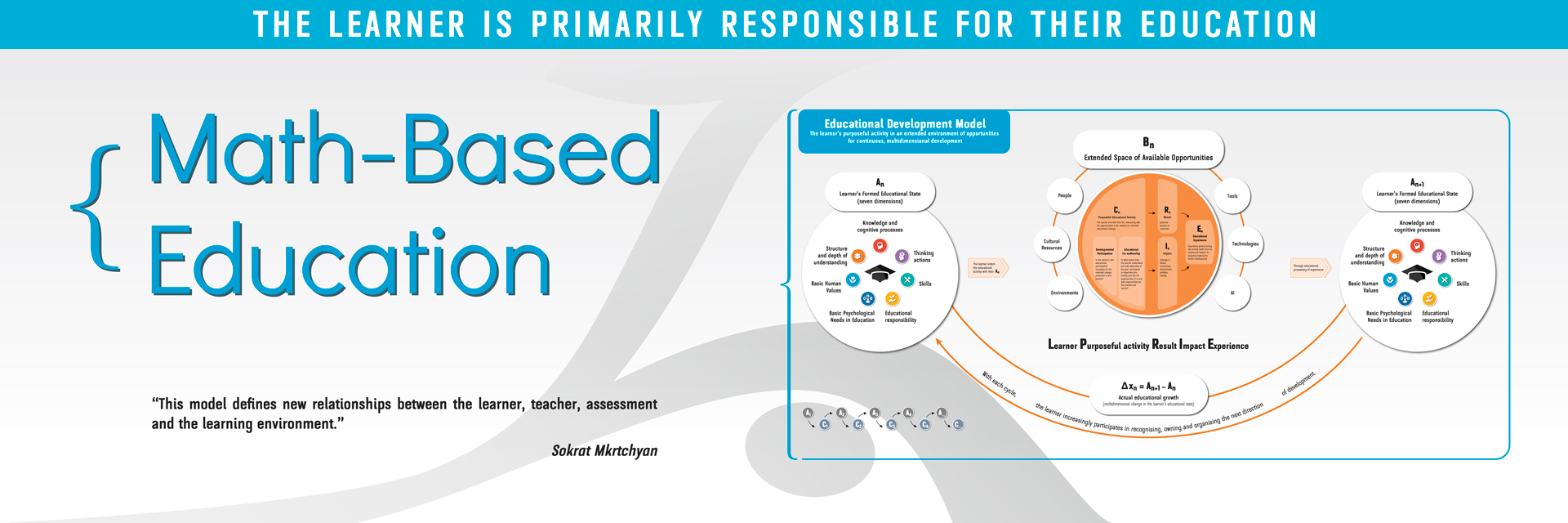
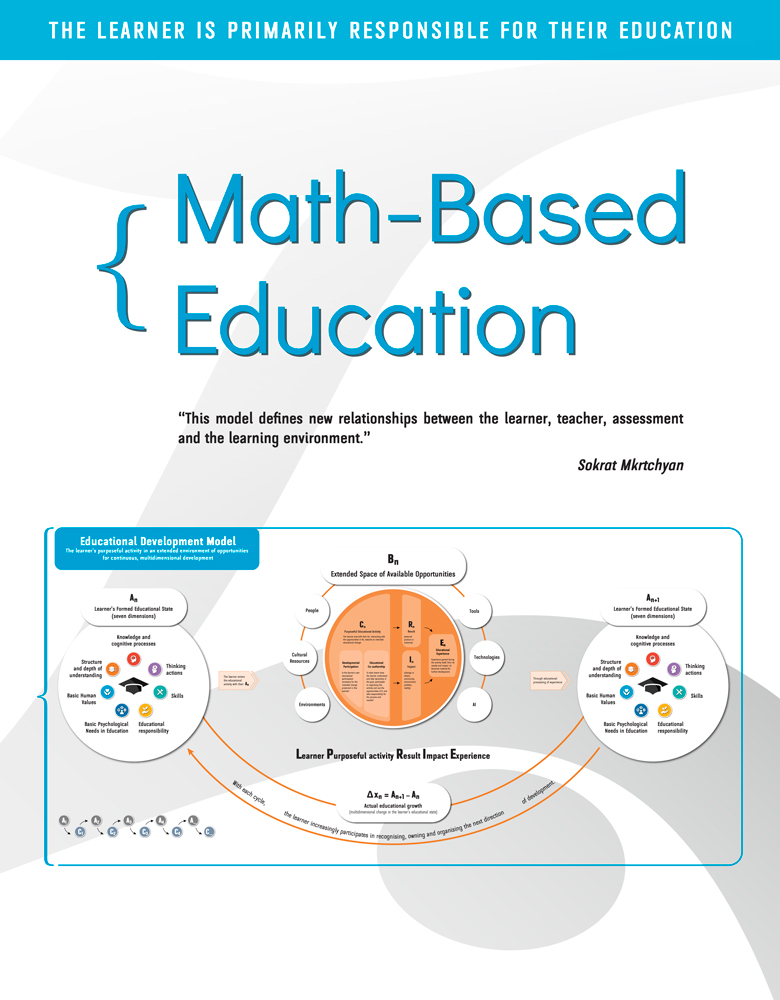
The core principle of the program is: "The learner is primarily responsible for their education". This objective shifts the learner into an active role in their educational journey: they learn to ask questions, explore options, experiment, analyze their own work, and evaluate their individual progress.
“Math-Based Education is not simply a program focused on traditional mathematics. Rather, it is an educational model where mathematics serves not just as an academic subject, but as a universal language of thought - a framework for recognizing connections, discovering patterns, modeling, reasoning, and verifying one’s own thinking processes. We structure the entire learning experience around this vision so that the student progressively assumes primary responsibility for their own learning, thinking, and educational growth.”
- Sokrat Mkrtchyan, Author of the Program
Under this model, mathematics functions as both a language and a key driver for cognitive development. Mathematical thinking enables students to uncover systemic relationships and underlying patterns, analyze complex scenarios, compare alternative solutions, and defend their rationale - skills that seamlessly transfer across other academic subjects and real-world problem solving.
Errors as Data in the Learning Process
A foundational concept of the program is: “An error is data, not a misdemeanor.”
Errors are treated as meaningful insights into a student’s internal thinking process. Rather than focusing solely on whether an answer is correct, the emphasis is placed on understanding the reasoning path the student followed to reach that conclusion. This diagnostic approach allows educators to pinpoint specific learning gaps, examine the chosen path, and continue the educational process grounded in authentic learner data.
Assessment as a Engine for Growth
The program employs a comprehensive seven-dimensional assessment system to evaluate learner progress across interconnected domains. A key proprietary tool integrated within this program is the "Passport of Learning Outcomes," a system designed to articulate targeted outcomes at every learning stage and track their development over time.
“Every subject-specific learning outcome (spanning all subjects in a given grade) is mapped through seven interconnected matrices outlined in the educational program. This reveals not only the core knowledge learners require but how they must think in order to cultivate values for their educational needs, and take ownership of their own education over time. Assessment follows this exact framework: the seven-dimensional system evaluates far beyond the final answer - it measures the learner's thought process, acquired competencies, and overall individual qualitative educational growth.”
- Sokrat Mkrtchyan
Technology as an Educational Facilitator
The curriculum incorporates advanced educational data analytics and artificial intelligence tools designed to support learning management and provide a holistic overview of student progress. Thus, the technology is not intended to replace critical thinking; rather, it serves as a high-precision diagnostic tool that provides accurate data to inform effective, personalized instructional decisions.
“The goal of Math-Based Education is not just finding the correct answer; it is understanding how the learner arrived at that answer.”
***
Following its rollout in Armenian schools, our team is expanding the program onto the international stage. Scheduled for presentation at global education forums in Singapore and Dubai, Armenia's "Math-Based Education" model is preparing to engage with the broader international professional community.
Math-Based Education (Grades 1–6)
Author: Sokrat Mkrtchyan
Zangak Publishing House, Yerevan 2026